logo
Zhenglan Cable Technology Co., Ltd
Products
News
Home >

China Zhenglan Cable Technology Co., Ltd Company News

Contacts
Contacts: Miss. Linda Yang
Fax: 86-371-61286032
Contact Now
Mail Us

How to prevent electric shock in rainy days?

1. There are wires in the street lamp pole. For safety, stay away from them on rainy days. 2. Construction section of the road. The road condition around the construction section is poor and complex, and the safety cannot be guaranteed. Once there are loopholes in the construction, it is easy to cause the "big scene" of "sky thunder and earth fire" 3. Power equipment. Generally, transformers and electric boxes are treated safely and are safe without active touch and climbing. However, the situation of rainstorm weather is complex, and various unexpected situations may occur. For safety consideration, please stay away from them. What should I do after an electric shock? 1. If someone is found to be electrocuted and fall to the ground in the water, do not rush to help with your hands, and make the electrocuted person quickly get out of the power supply. When there is a power switch or socket around, pull down the switch or unplug the power plug immediately; If the power supply cannot be disconnected, use a dry wooden stick to pick up the wire on the person who gets an electric shock. 2. After an electric shock, the human body often appears "fake death". To carry out first aid for the injured by electric shock, make them lie flat on their back on the spot and ensure that the airway is unblocked. Judge whether the injured has breathing by observing whether the injured has breathing movement in the abdomen and chest corridor, or by touching whether the neck artery beats. If no breathing is found, resuscitate immediately and contact the emergency center.  
2021/09/02

What is the bending radius of cable?

The bending radius of the cable can be explained from two aspects: one is the bending radius of the cable itself, and the other is the bending radius of the cable during construction and laying. The calculation of the minimum bending radius of the cable is introduced below. The standard of the bending radius of the cable is complete. 1. Calculation of cable bending radius If the outer diameter of the cable is 10mm, the allowable bending radius of the cable is 15 * 10 = 150mm. That is, when the cable is bent (at the corner), it is an arc bend. The arc bend can be based on the intersection of the vertical line of the tangent at any two points on the arc, that is, the radius of the arc, which should be greater than or equal to 150mm. 2. Standard for cable bending radius Plastic insulated power cable of 35kV and below and plastic insulated control cable For non armored cable, it shall not be less than 6D of the outer diameter of the cable; Armored or copper tape shielded cable shall not be less than 12D of cable outer diameter; Shielded flexible cable shall not be less than 6D of the outer diameter of the cable. 2. 1 GB50303-2002 code for acceptance of construction quality of building electrical engineering The bending radius at the turning of the cable tray shall not be less than the minimum allowable bending radius of the cable in the tray. The minimum bending radius of PVC insulated power cable is 10d; The minimum bending radius of XLPE insulated power cable is 15d; The minimum bending radius of multi-core control cable is 10d. 3. For bare conductor, usually the bending radius cannot be less than 30D
2021/08/14

Features Of Aerial Bundled Cable

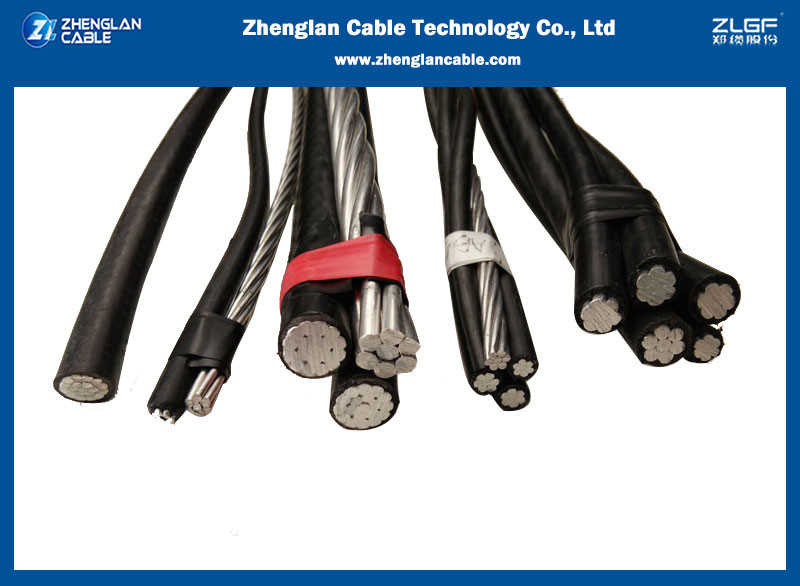
Overhead insulated cable has the main characteristics of high power supply reliability, good power supply safety, convenient erection and maintenance and reasonable economy 1. High power supply reliability. The use of overhead cable can greatly reduce all kinds of short-circuit faults (especially the common flashover faults of overhead bare conductor), and the fault rate is 4-6 times lower than that of overhead bare conductor. 2. Good power supply security. When the overhead cable is energized, when the human body or other animals accidentally touch the cable insulation surface, as long as the cable is not broken down, it will not cause harm to people and animals. 3. Convenient erection and maintenance. Overhead cables can be erected on any kind of pole and tower or along the wall. In special cases, they can also pass through the trees and be directly fixed on the tree pole with hardware. There is no need for special patrol inspection, and there will be no short-circuit tripping accident due to branch flashover, littering by residents, or false collision of crane boom, which greatly reduces the maintenance and overhaul of the line. 4. Reasonable economy. Although the overhead cable is more expensive than the overhead bare conductor, it is cheaper than the ordinary underground installation cable. Therefore, although the one-time investment of overhead cable is slightly higher, combined with other factors, its operation cost will be significantly lower than that of overhead bare conductor. Zhenglan Cable Technology Co., Ltd can produce different types of aerial insulated cable as per different standards inculding IEC, NFC-33109, AS NZS3560, etc.. Welcome your inquiry.
2021/08/06

What is a waterproof cable?

Cables that can be normally used in water are collectively referred to as water blocking (waterproof) power cables. When the cable is laid underwater, it is often immersed in water or wet places, the cable is required to have the function of water prevention (resistance), that is, it is required to have the function of full water resistance, so as to prevent water from immersing into the cable and causing damage to the cable and ensure the long-term stable operation of the cable under water. The difference between waterproof cable and ordinary cable is that ordinary cable cannot be used in water. Waterproof cables mainly fall into the following three categories: An oil paper insulated cable is the most typical water-resistant cable. Its insulation and conductor are filled with cable oil, and there is a metal sheath (lead sheath or aluminum sheath) outside the insulation. It is the cable with the best water resistance. In the past, oil paper insulated cables were mostly used for submarine (or underwater) cables, but oil paper insulated cables are limited by the drop, which has the trouble of oil leakage and inconvenient maintenance. Now they are used less and less. Second, the ethylene propylene rubber insulated cable widely used in medium and low voltage underwater transmission lines is due to its superior insulation performance without the worry of "water tree". Waterproof rubber sheathed cable (JHS type) can operate safely in shallow water for a long time. Three crosslinked polyethylene (XLPE) insulated power cable has become the most widely used insulating material because of its excellent electrical, mechanical and physical properties, simple production process, light structure, large transmission capacity, convenient installation, laying and maintenance, and not limited by drop. However, it is particularly sensitive to moisture. If the insulation is soaked with water during manufacturing and operation, It is prone to "water tree" breakdown, which greatly shortens the service life of the cable. Therefore, XLPE insulated cables, especially medium and high voltage cables under AC voltage, must have "water blocking structure" when used in water environment or humid environment. The so-called "water blocking structure" includes radial water blocking structure and longitudinal water blocking structure.
2021/07/23

Characteristics and application occasions of fire-resistant and flame-retardant cables

1. fire-resistant XLPE insulated, PVC sheathed power cable It can be laid indoors, in tunnels and pipelines, and can withstand certain laying traction, but the cable cannot bear external force, and single-core cable is not allowed to be laid in magnetic material pipelines. If you need to bear the external force of machinery and wrap the steel tape armour. Suitable for special requirements, such as large-capacity power plants, nuclear power plants, underground railways, high-rise buildings, etc. 2. XLPE insulated, PVC sheathed power cable It can be laid indoors, in tunnels and in pipelines, and can withstand certain laying and traction, but the cable cannot bear external force, and single-core cable is not allowed to be laid in magnetic material pipelines. If you need to bear the external force of machinery and wrap the steel tape armour. 3. Flame retardant PVC insulated, PVC sheathed power cable It can be laid indoors, tunnels, cable trenches, pipelines, flammable and severely corroded places, but cannot bear external mechanical forces. If you need to bear the external force of machinery and wrap the steel tape armour. Features: In the case of open flame burning, remove the fire source, ≤ 12S automatic extinguishing. 4. Flame retardant cross-linked polyethylene insulated, polyvinyl chloride fuel sheathed power cable It can be laid indoors, in tunnels and pipelines, and can withstand certain laying traction, but the cable cannot bear external force, and single-core cable is not allowed to be laid in magnetic material pipelines. If you need to bear the external force of machinery and wrap the steel tape armour. Features: In the case of open flame burning, remove the fire source, ≤ 12S automatic extinguishing. 5. Fire-resistant PVC insulated, PVC sheathed power cable It can be laid indoors, tunnels, cable trenches, pipelines, flammable and severely corroded places, but cannot bear external mechanical forces. If you need to bear the external force of machinery and wrap the steel tape armour. Suitable for special requirements, such as large-capacity power plants, nuclear power plants, underground railways, high-rise buildings, etc.
2021/07/03
15 16 17 18 19 20 21 22 23 24
Privacy Policy | China Good Quality Aluminum Power Cable Supplier. Copyright © 2019-2025 Zhenglan Cable Technology Co., Ltd . All Rights Reserved.