logo
Zhenglan Cable Technology Co., Ltd
Products
News
Home >

China Zhenglan Cable Technology Co., Ltd Company News

Contacts
Contacts: Miss. Linda Yang
Fax: 86-371-61286032
Contact Now
Mail Us

What kind of cables are used in photovoltaic power station?

In the process of photovoltaic power station construction, in addition to the main equipment, such as photovoltaic modules, inverters, step-up transformers, the supporting connected photovoltaic cable materials also play a vital role in the overall profitability, operation safety, and efficiency of the photovoltaic power station. The following is a detailed introduction to the use and use environment of the common cables and materials in the photovoltaic power station.   According to the system of photovoltaic power station, cables can be divided into DC cables and AC cables, which are classified as follows according to different uses and environments: 1. DC cable (1) Series cables between components. (2) Parallel cables between strings and between strings and DC distribution box (junction box). (3) Cable between DC distribution box and inverter. The above cables are DC cables, which are laid outdoors. They need to be moisture-proof, sun proof, cold resistant, heat-resistant and UV resistant. In some special environments, they also need to be resistant to acid-base and other chemicals. 2. AC cable (1) Connecting cable from inverter to step-up transformer. (2) Connecting cable from step-up transformer to power distribution device. (3) The connecting cable from the power distribution device to the power grid or users. This part of the cable is AC load cable, laying more indoor environment, can be selected according to the general power cable selection requirements.   Zhenglan Cable Technology Co., Ltd can supply you both AC&DC use cables. Welcome your inquiry.
2021/07/03

What are the factors affecting insulation resistance of wires and cables?

1. Ambient temperature: The coefficient of insulation resistance is closely related to temperature. The higher the temperature is, the smaller the insulation resistance is. This is a conclusion drawn from numerous experiments and practices. The coefficient of insulation resistance decreases exponentially with the increase of temperature, while the conductance (power conduction) power increases with the increase of temperature.   2. Humidity effect: Conductance -- a parameter indicating the current transmission capacity of a conductor. The conductivity of water is large, and the water molecule is much smaller than that of polymer (cable sheath material). When the surrounding humidity is high, the water molecule is easy to penetrate into the insulation, resulting in the increase of conductivity and the decrease of cable insulation resistance.   3. Purity of insulating material: Insulation refers to wrapping the charged body with non-conductive material. What if the purity of insulating material is not enough? What about the conductive materials mixed in the insulating materials—— There is no doubt that this will reduce the insulation resistance of the cable, and ultimately affect the quality of the finished cable. This is an important factor affecting the insulation resistance of cables. Cable insulation resistance is one of the main electrical properties of insulating materials, which is an important index to measure wire and cable products. Once it is lower than a certain numerical standard, it will lead to low power transmission efficiency, waste of power, increase the probability of cable breakdown and increase the risk. Therefore, we must pay attention to this key issue when purchasing wires and cables.
2021/06/10

Function and difference of metallic shield for medium voltage cable

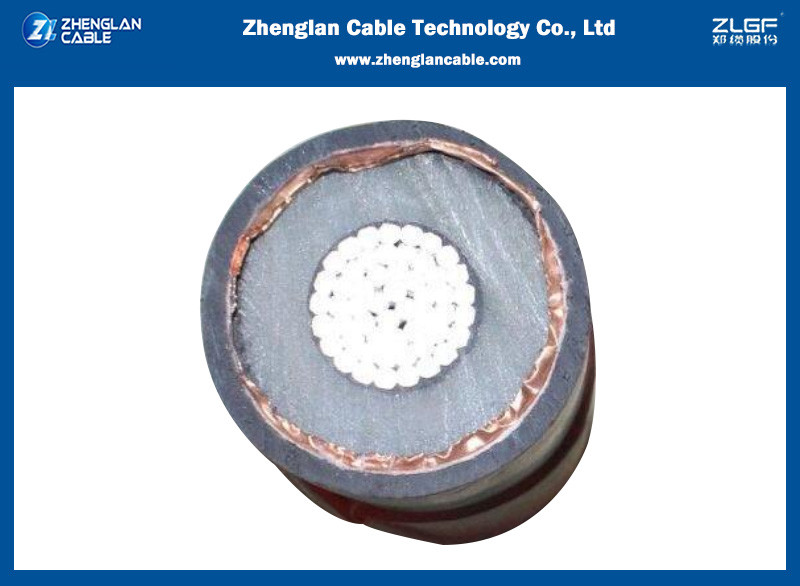
As an important structure of medium voltage power cable, metal shielding layer will pass capacitive current under normal operation of the cable, and act as the path of short-circuit current in case of short circuit; At the same time, the electromagnetic field generated when the cable is electrified is shielded in the insulated core to reduce the electromagnetic interference to the outside world.   The copper strip shielding is composed of a layer of overlapped soft copper strip, and the double-layer copper strip can also be used for gap wrapping. The nominal thickness of copper strip for single core cable shielding is not less than 0.12mm. The copper wire shield is composed of loosely wound soft copper wire, and its surface is tightly tied with reverse wound copper wire or copper tape. The average gap between adjacent copper wires shall be no more than 4mm.   The shielding method of copper wire and copper strip winding can improve the disadvantages of shielding method of copper strip winding from the structure. It has neither oxide layer produced by copper strip overlapping, nor strong bending and hot and cold deformation, and the copper strip winding is not easy to arch and embed into the insulation shielding layer. The cross-section of the metal shield directly affects the ability of the cable to withstand the short-circuit current in case of fault. If the cross-section is too small, the short-circuit current will overheat or burn out and damage the insulation. Therefore, it is necessary to determine the cross section of metal shield according to the fault current capacity.   In 10kV and below cable, when conductor section is more than 500, try to use copper wire shielding! If you insist on using copper tape shielding, you need to thicken the thickness of copper tape! According to the conditions of cable laying, if it needs to carry a large short-circuit current, it is recommended to use copper wire shielding. Therefore, the difference between copper tape shielding and copper wire shielding is the ability to carry short-circuit current. Copper wire is slightly larger (also depends on the effect of copper wire). Copper tape is homogenizing magnetic field and shielding.  
2021/05/21

Water blocking cable design and their benefits

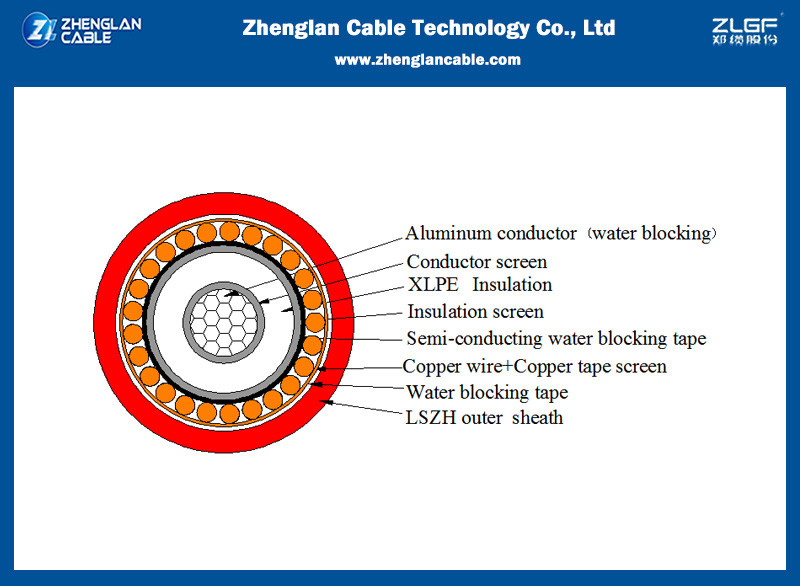
With the deepening of research and understanding of insulation water absorption and water tree, people are more and more aware of the importance of waterproof performance for medium and high voltage power cables. In areas where the groundwater level is high or rainy all the year round (such as the area south of the Yangtze River in China). More and more users have put forward waterproof requirements for cables. Most of the power cables are directly buried, so the cables are very likely to suffer from soil pressure and external force damage due to human factors. From the perspective of laying forms, most foreign countries use metal protective sheaths for mechanical protection and waterproofing, or use cables covered with thin metal tapes and other waterproof layers. However, once this kind of cable is damaged, water will invade the inside of the cable from the damage, and then penetrate into the gap inside the cable (between conductor strands, extruded semi-conductive layer, shielding layer or metal sheath, etc.). Extend longitudinally along the cable, making long cables unusable. When the directly buried cable fails, a new cable is usually replaced at the point of the accident to restore the line. Therefore, once water penetrates into the cable, the water seepage distance should be as short as possible. In order to prevent water seepage after immersion, generally The gap part is used to wrap the water-absorbing swelling material, once it is immersed in water, the gap can be easily blocked. Generally, the sheath material used in cables is polyvinyl chloride, and polyvinyl chloride molecules are polar. Polar water molecules can easily penetrate into the cable through the polyvinyl chloride layer. At present, it is necessary to realize the longitudinal water-blocking technology of the cable. There is no problem with the above, as long as a layer of water-blocking material made of water-tight material is added to the jacket. The currently commonly used method is to squeeze a layer of medium-high density PVC inner jacket in the PVC outer jacket or longitudinally wrap a layer of aluminum-plastic composite tape as the longitudinal water-blocking isolation jacket. Polyethylene is easy to absorb water under an alternating electric field, which does not mean that the water tightness of the polyethylene material is not good. The water tightness of polyethylene material is hundreds of times higher than that of polyvinyl chloride. The extruded polyethylene water blocking layer and a layer of moisture-absorbing cushion (such as water blocking tape) can meet the longitudinal resistance of cables laid in general humid environments. Water and moisture-proof requirements. The use of polyethylene material in the water-blocking isolation sleeve is relatively simple in process, and it can be realized without adding any production equipment. Because the polyethylene layer is only used as a water-blocking layer without considering its mechanical strength and other factors, a good effect can be achieved when its thickness is 1.0~1.5mm during process design due to cost and process considerations. Water blocking tape (yarn) can quickly swell in contact with water and reach a certain swelling height and can form a high-strength gel. It is an ideal active water blocking material, using water blocking tape, water blocking rope, and water blocking As a water-blocking material, yarn has simple process and convenient construction and high production efficiency. Therefore, this structure is generally welcomed by users and manufacturers. Because the contact surface between the single-core cable insulation and the sheath is relatively flat, as long as it is between the outer sheath and the core Wrap a layer of water blocking tape to achieve a good longitudinal water blocking effect. If there is a metal shield, you need to wrap the semi-conductive resistance hose on the inner side of the metal shield. Multi-core cables also need to be effectively filled with water-blocking ropes and water-blocking yarns in the gaps between the cable cores, and then wound with water-blocking tapes. For cables with armored layers, it is also necessary to use two layers inside and outside the armoring layer. A layer of water blocking tape is wrapped around each side. Zhenglan Cable Technology can meet your special requirements in cable's water prevention. Welcome your inquiry.
2021/04/16
16 17 18 19 20 21 22 23 24 25
Privacy Policy | China Good Quality Aluminum Power Cable Supplier. Copyright © 2019-2025 Zhenglan Cable Technology Co., Ltd . All Rights Reserved.